
First published via Substack: sign up there to receive the new posts via email.
Over a year ago I wrote an early design diary and started toying with the idea of an immersive training experience to train participants in marketing principles. I ended up setting this project to the side for a while but picked it back up a couple of months ago and have managed to make enough progress to have a rough prototype and test it with a strategy director friend.
Sharing early design diaries feels slightly uncomfortable because it’s imperfect and still in progress, though it’s also is quite common in tabletop game design communities (you can read many on BoardGameGeek), so I’m taking the same kind of approach here.
To slot in a reference in the hopes of surfing current news, the designers and producers of GTA VI waited over thirteen years because as arguably the most massive and expensive cultural product ever put together, they wanted to make sure it was absolutely ready with little to no glitches. I haven’t played it, but apparently they moved the needle towards more verisimilitude compared to GTA V, something to do with fixing rooftops and not being able to steal cars as easily as before. This has nothing to do with what I’m working on though, and I’m not even playing GTA at all so this paragraph is totally superfluous.
I started with an ambitious scenario of playing through a situation like that of Nokia as a market leader when the iPhone was released. However, it was pretty complex in practice so I considered how I could chunk it some kind of proof of concept experience first.
There are a few challenges and moving parts, so I set a few arbitrary constraints: Design an experience with one simple enough learning objective, that can be experienced in an hour.
My reasoning is that I’m going to want to show this once ready, first for testing and feedback, and then to sell as a product. Something with the original scope of experiencing complex marketing decisions is likely to be at least a half day long or more. I would still need to be able to demonstrate how it works in an hour or under. The other ambition is to design an engine, or system, that can be adapted and customized to a client’s own industry or even specific brand for training purposes.
I’d started with the four Ps of marketing as a first idea to make into measures and decisions, though moved away from that for this prototype. Instead I set three abstracted measures for this experience in an hour:
Sales volume
Profit margin
Brand affinity
I arbitrarily set levers with a maximum of 12 tokens, and set the business as a popular fast food chain. I might change that to a kind of consumer packaged good though (CPG/FMCG).
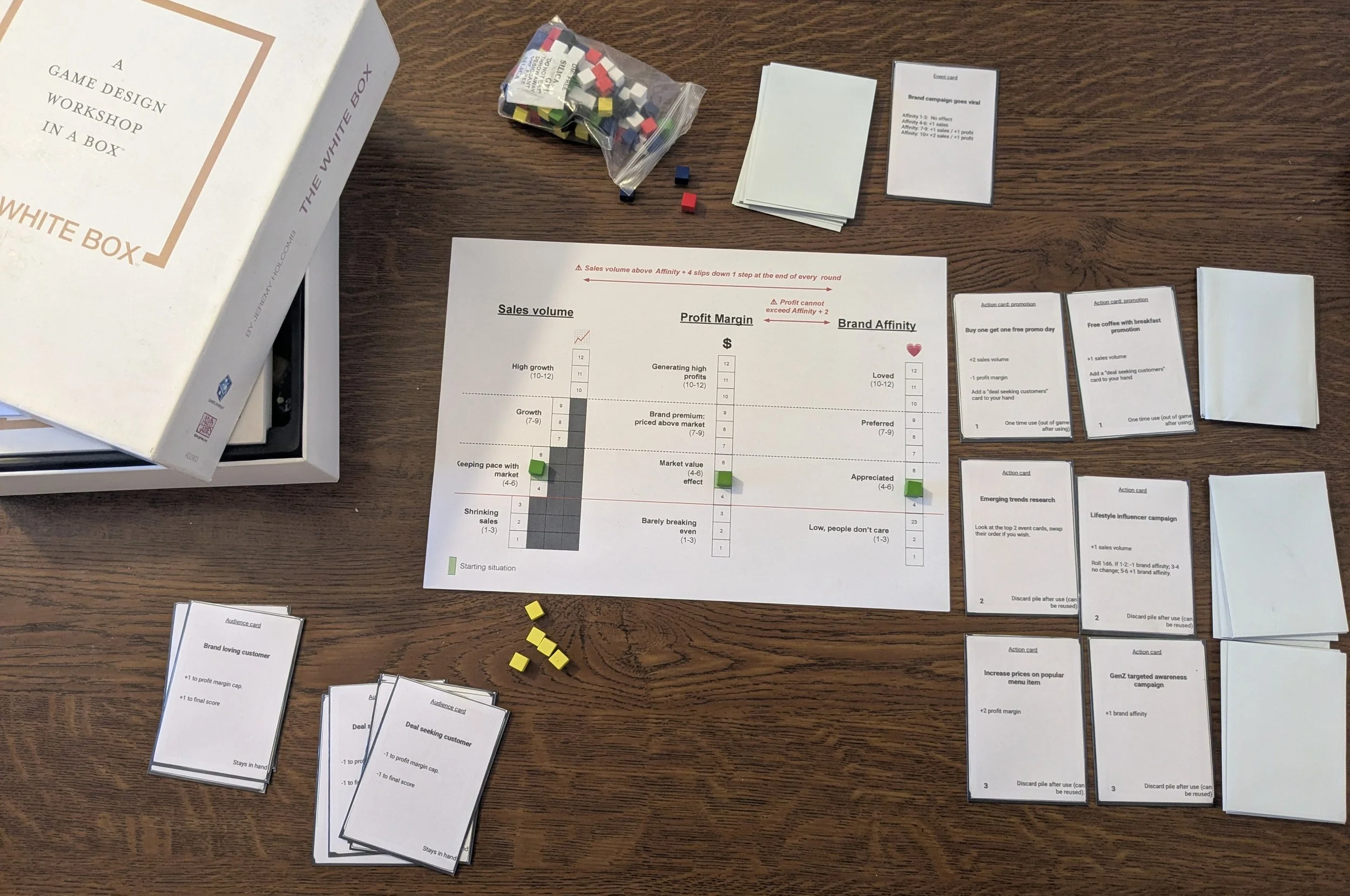
This is what the first prototype looks like. Of course there is little to no visual design so far, for now I’m testing and tweaking how the experience works.
To be played in an hour or less, it needs to be simple to understand and easily accessible for everyone, and that’s something true for a longer version too. I think it should be easy to get for anyone who’s only ever played Monopoly (or other roll and move games).
It’s designed for one person or a small group of two or three people. In order to scale it, there would be multiple teams of two or three people competing with one another.
Participants receive budget tokens (the yellow cubes at the bottom of the levers in the image), and they use these to buy action cards, representing marketing communications activities that will move the levers up and down. An event cards deck represent fluctuating market situations that happen at every round, good or bad.
The stated goal for participants is to increase the three levers up as much as possible in five rounds. The main idea from a training objective is to get and appreciate the difference between sales promotion activities that tend to increase sales at the expense of profit margin; and with brand building activities that tend to be more expensive but increases how much people appreciate the brand, and perceive it as more valuable (to generate higher profit margins).
You receive five budget tokens to spend at the beginning, and levers are placed at five as well, meant to mean it is at a standard kind of middle ground starting situation. Activities cost one, two, or three tokens to purchase.
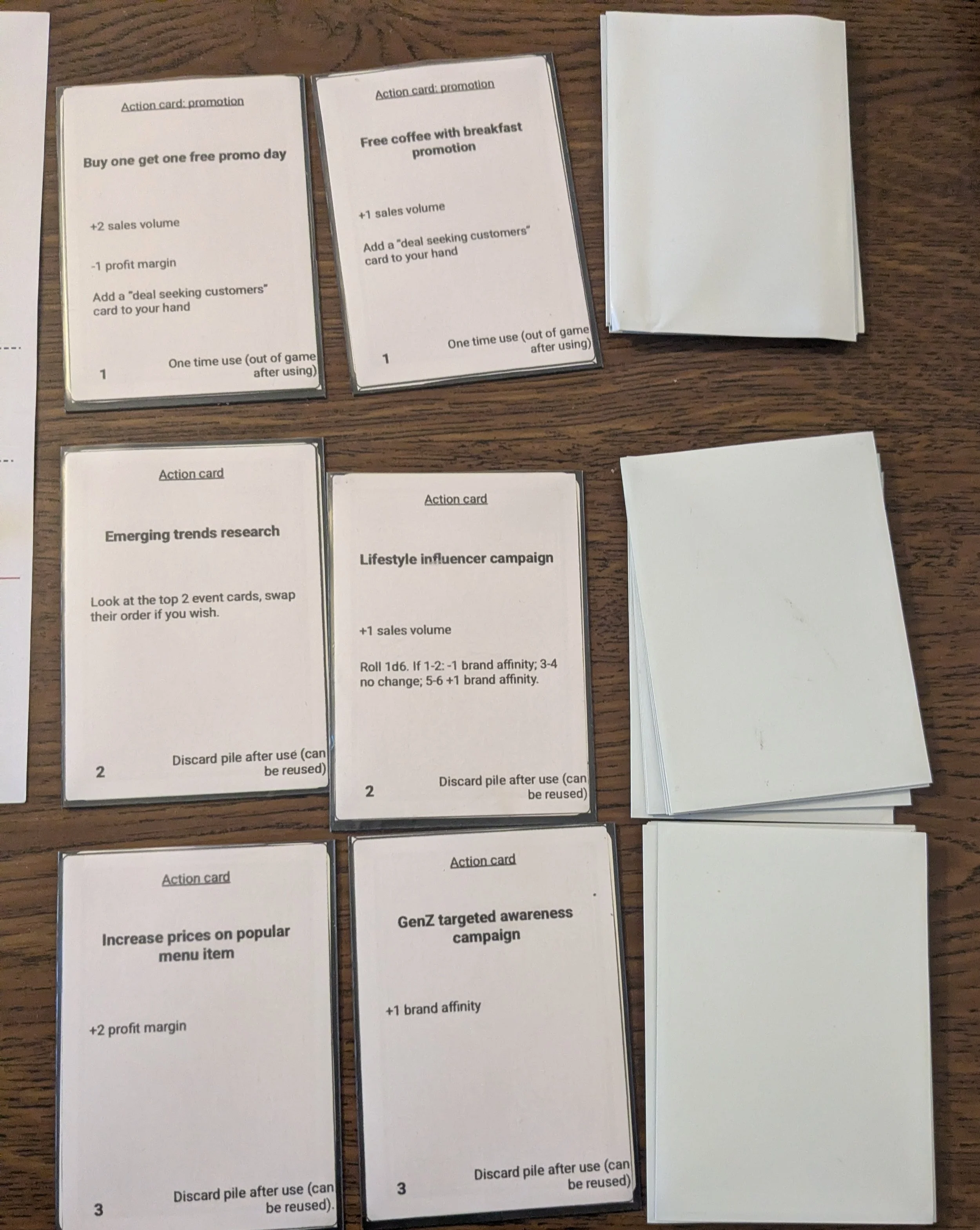
I’m testing action/activity cards to become available through a card drafting system (like in Splendor or many deck building board games), with a mix of always available base actions, and some that cycle through with more irregularity.
I’m also testing different ways to acquire budget every round and final score, but in short if the levers go up, participants have more budget to spend on activities for the following round.
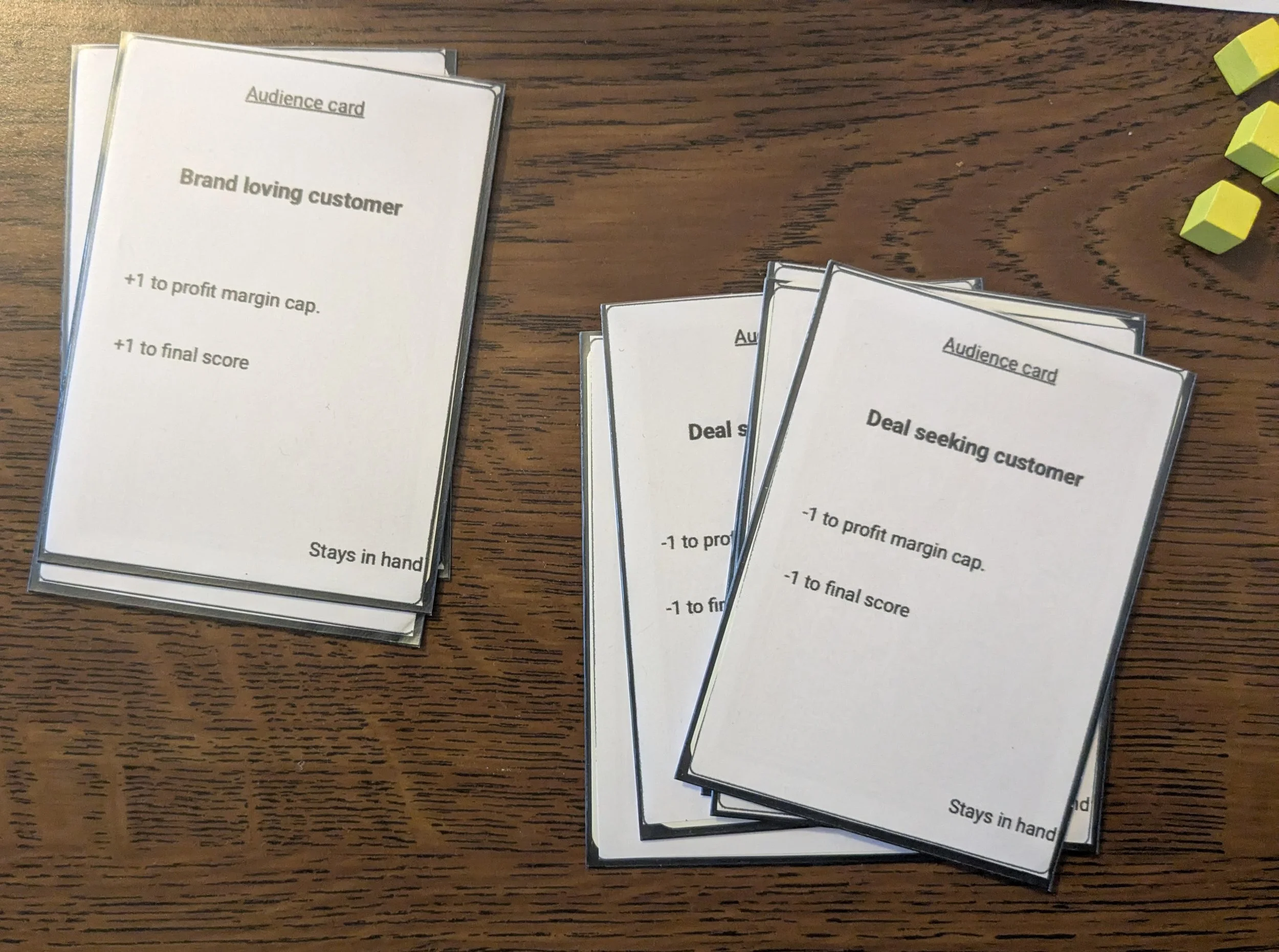
Customer cards are a way to impose penalties: run too many promotions and get customers only looking for a good deal; or give bonuses like customers who love your brand.
I tested it by myself a few times and while still early felt ready to show it. I organized a drink with Filippo who was gracious enough to play through the whole experience and gave me some great feedback. I have lots to ponder in order to improve for the next test, including the stated goal for participants, improving on the background and training content during the experience (e.g. showing and explaining relevant marcomms principles between rounds, discussing decisions as they’re being made), and amending a few more things (important ones, like making sure participants get instant value from decisions made).
The most important point to keep as a guiding light is the objective for the experience, and the learning or training. In this case, I want it to be valuable for students and for marketing communications professionals (probably junior to mid level, though perhaps senior people too). I’m not sure I can keep it to an hour in this version though. Plus the value of playing as a team is limited right now, that can definitely be improved.
One of my concerns is if I add more complexity and training elements I’m not sure it fits as an hour long experience anymore.
My original intention was also to get something ready as quickly as possible so in parallel I started working on a brand positioning deck of cards to be used in client workshops that I’m beginning to test and will write about in my next article.
PS: I’ve been wondering, and still am, how insane I am for playing around with analog experiences in the age of AI tools. On the other hand, analog is the way to go for more and better learning experiences. So far six European countries have announced ditching tablets and screens in favor of paper books, because of falling PISA scores, among other reasons. While there are amazing sounding agentic things coming through, a lot of AI seems to be both a race to the bottom and towards destruction. I’m feeling ambiguous about it all, at best. That said, a friend of mine felt compelled to add an AI training programme to his website, and I’m wondering about that too, as in what’s worth signaling. While I can be critical and always feel like I’m behind I still follow a lot do to with AI tech, and often find I know more than at least some other professionals I anecdotally chat with.
