
System matters applied to designing immersive training games for marketing communications
The marketing communications industry has a close historical relationship with the business of war. You may already well be aware. Still, I discovered a few new threads around the topic a few months ago that caught my attention, I explored a little further and now sharing here.
A couple of background notions:
State governments found the need to communicate widely during the first and second world wars, as part of that the industry grew massively. In the USA for example, shortly after Woodrow Wilson’s reelection and upon entering WWI, in 1917 he launched a temporary agency, the Committee on Public Information (CPI), considered to be the first “modern state propaganda office” (and at the time the term wasn’t considered pejorative).
Though which state was really first is probably debatable given France passed new laws to censor the freedom of press as early as August 1914 in order to control the war narrative and manage public opinion. “Le Bureau de la Presse” created at the same time within the War Ministry employed 400 censors in Paris and 5,000 regional agents, according to this article. New media and technologies are swiftly put in service of mass communication to shape a clear good vs. evil / us vs. them story.
While anecdotal, I’ll mention the lexical field of marketing, advertising and even business at large is telling; we talk about strategy, tactics, campaigns, targeting, propaganda, guerilla, etc.
These topics are extremely relevant now, in France and around the world. Here kids are being arrested wholesale and mutilated by the police under state orders because they dared ask for teachers and decent learning conditions in high school. Meanwhile, the main story on television and out of the government is only about burning trash cans and demonizing the political left.
I digress. More on that over on my personal blog soon.
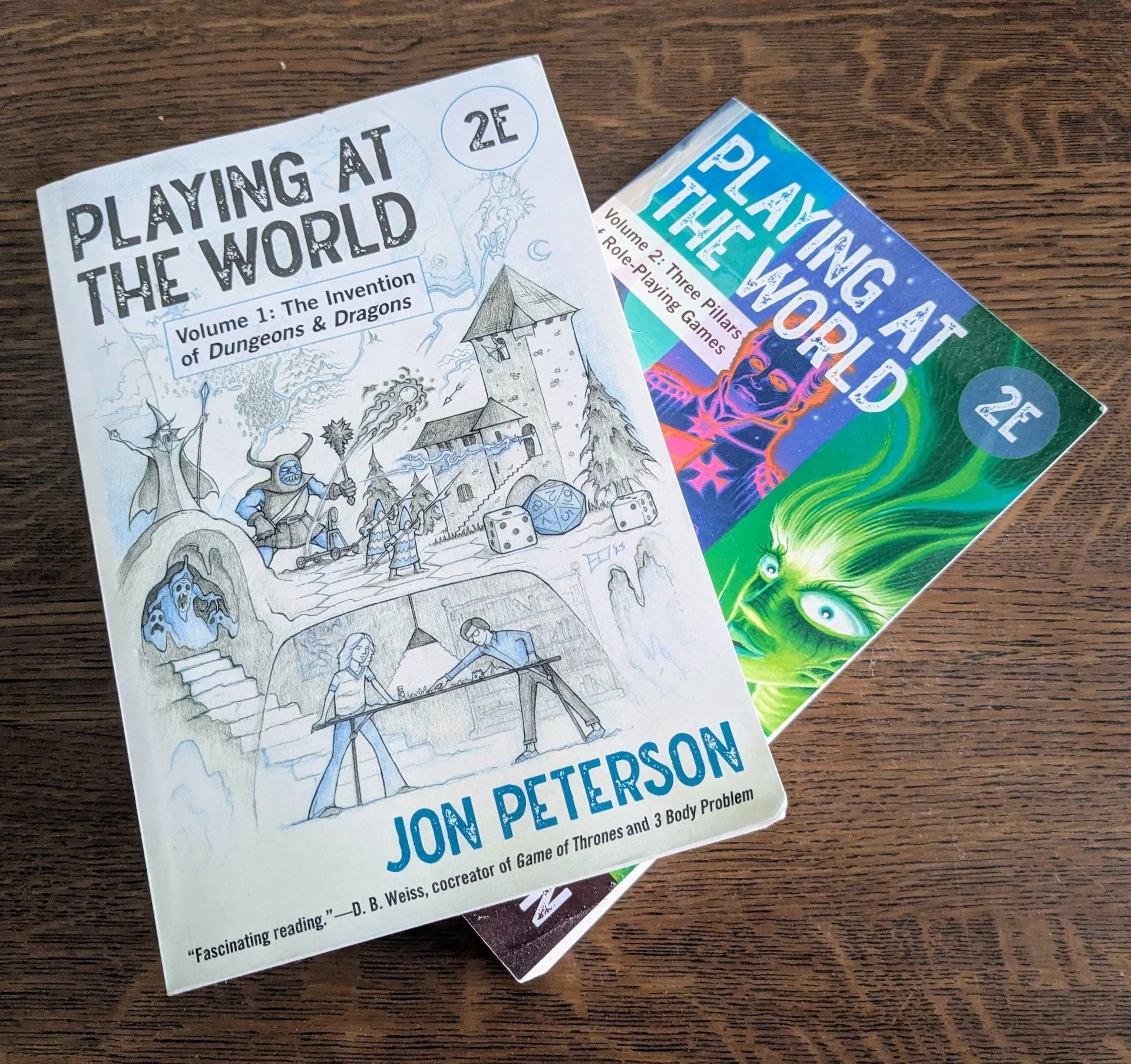
I was reading Playing at the World (2E, vol. 1), a book tracing the history of the creation of Dungeons and Dragons in minute detail. That story is about wargames first, themselves inherited from the Prussian army invention of Kriegpsiel in the early 19th century, typically seen as the first of the genre (discounting chess I suppose, that’s a whole other story). By definition, a strategy game attempting to simulate elements of warfare, typically on a detailed map (or diorama), with figurines representing military units, two opponents and a referee (umpire). I will admit that so far I only briefly skimmed the extensive amount of information about the history of wargame mechanics in the second volume of Playing at the World.
In the book, after briefly mentioning the Prussian tradition, the author Jon Peterson mentions that Charles Swann Roberts, considered the father of modern board wargaming, happened to work for an advertising agency in 1952 when he began designing Tactics. As a point of reference, Risk was published in 1959.
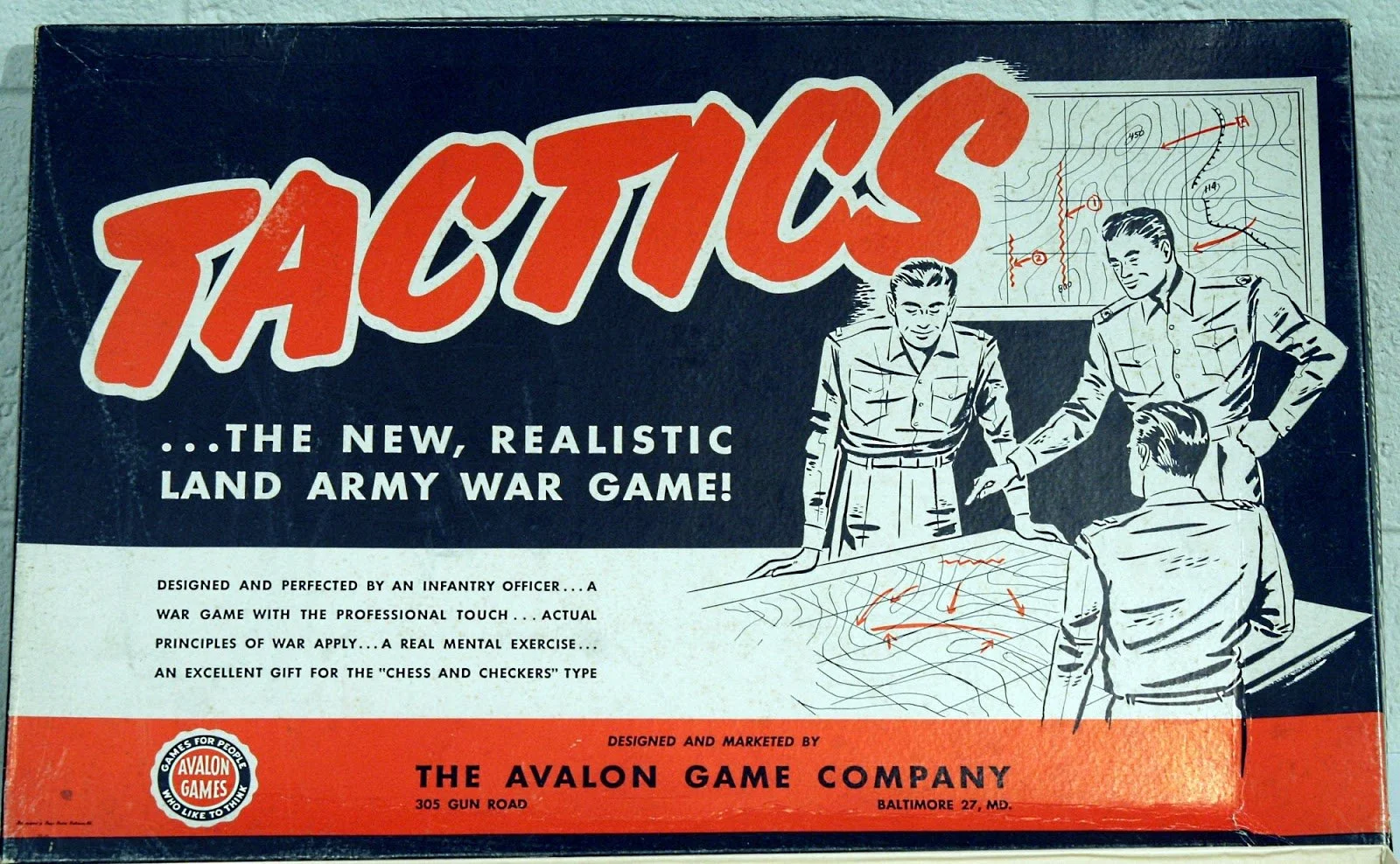
Charles S. Roberts enlisted in the army in 1948, and after being discharged in 1952 started working at VanSant Dugdale & Co. a historic ad agency. Remarkably given these days of massive networks and global consolidation, the agency still exists. It ‘only’ merged/absorbed with another local agency in 1991 to become Gray Kirk/Van Sant, today GKV.
He begins an article he wrote in 1983 by admitting he didn’t have much thought or premonition when he first sat down to begin designing what is known as the first modern board wargame.
He did have an intention though, and I find it particularly interesting:
“To be conversant with the Principles of War is to a soldier what the Bible is to a clergyman. The Bible, however, may be readily perused. . . wars are somewhat harder to come by.
Thus I decided that I would practice war on a board as well as the training field and learn the nuances of the Principles of War in a context that was less noisy. Since there were no such wargames available, I had to design my own [...]”
and
“I soon learned that playing a realistic game had very real training value and at least some predictive aspects.”
He decided to market his game to the general public when it was ready a couple of years later, and it was sold at a local department store for Christmas. He also used his advertising experience to target the right audience, notably with a small ad purchased in the Marine Corps Gazette.
It seems the groundbreaking mechanic that stood Tactics apart is the idea of units having an abstracted “combat factor” number which is used to solve conflicts with a dice roll and reading results from a combats results table that summarises the odds in a swift read. This kind of sliding scale results table formed the backbone of board wargames for many years, and is still used in many board games and training simulations.
The map board is designed and stylized to represent a variety of terrain and can be used to simulate different situations, rather than simulate only one from a real past battle.
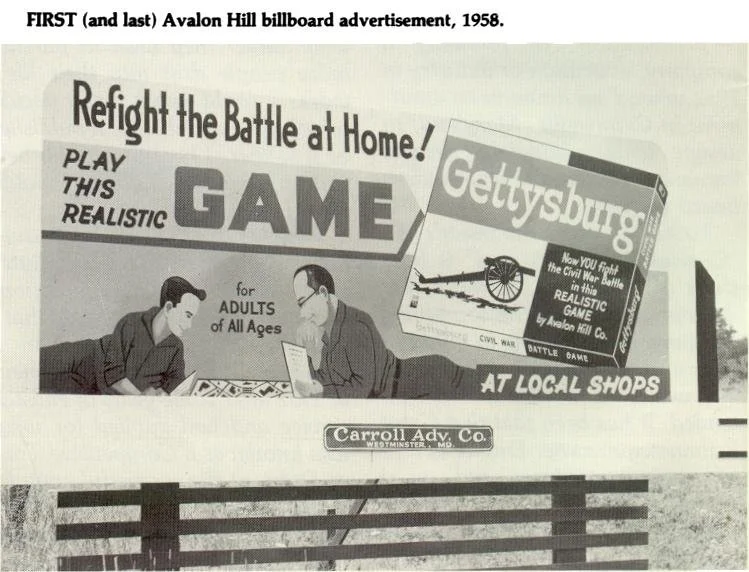
In other words, the game’s underlying system could be used for any battle. The Civil War Centennial was upcoming, and seeing some success with his first title, he published a new version of his game simulating the battle of Gettysburg. He even created their first and only billboard advertising campaign for the occasion.
It’s obvious I enjoy the general idea of a game situation to learn the principles of something and practice decision-making. And the Markstrat marketing game designed by professors at business school INSEAD seems to still be doing pretty well.
Even now with more innovation, departments of defense, or cyber-security simulation games taking place, some people don’t seem to take it seriously or credibly. Just as an anecdote; last year I went to the French wargaming association’s conference, taking place at the French Defense Ministry Innovation Lab (my first time there, not somewhere I usually hang out). When I arrived, I happened to walk in the elevator with another gentleman, I said hi and asked if we were going to the same place. He smirked and said something like: “the weirdoes meeting? Oh no. I’m a psychologist on another floor though, so if you need help later on, don’t hesitate.” It was a joke; a bad one to imply that adults who play games need psychological help.
Thankfully, others agree with the value of games for learning and training. I was recently invited to test an innovation business game prototype, in which teams of professionals (or students) are set to manage a fictional German robotics company over the course of five rounds representing five years of decision making, with consequences, learning and discussion along the way. Kind of like the Markstrat game mentioned, though not about marketing. The team I was in arrived second out of the five present, not too bad.
It was a great experience, and it’s a rich exercise. The designers have invested much work in factual, realistic background information and a nifty browser-based interface (vibe coded, I’m guessing). After the initial round of reading up more data about robotics than we could chew and the 19 different types of actions we could take on in 30 minutes allocated, quickly I think we all kind of gave up on the background documentation and tried to figure out the underlying system mechanics that could lead to a win condition, which in that case was maximizing the projected long term revenue for the business. In other words, which choices lead to the highest scores, regardless of whether it was about expanding the business to another continent or launching humanoid robots (we were later told that was a losing option; unsurprising to most people in the room who had suspected it).
What was interesting is that “winning” wasn’t necessarily part of the learning objectives, which we discussed at the end while debriefing. I believe the mechanics should ideally be matched with the experience of the game, what you take away from it, or what you learn from it. Something I used to chat about at length with friends in an audio podcast about tabletop roleplaying game theory. In that contest the phrase often used is “system does matter” or “system matters” to mean that the mechanics of a game significantly influence the play experience. Same idea, the system matters to the learning experience. The idea and phrase comes from game designer Ron Edwards who first about it on The Forge (a now archived web forum about tabletop roleplaying game design).
I’ve been working on a training prototype applied to learn a principle of brand building. It turns out “system matters” is much harder said than done, though I’m nearly there. The invitation to participate in the prototype was a welcome surprise, it gave some motivation to get back at it and after printing a few early version cards I’ll be ready to show a few people and gather feedback, test and improve in the next few weeks.
Subscribe below to receive the next posts directly in your inbox:
